We sang the song Oceans in church, a few months after our daughter was stillborn. I used to love that song. I always longed to walk in faith wherever God would lead me. But now I found myself not being able to sing it. What if going wherever He leads would mean I lose another child? I suddenly realized I didn’t trust God anymore. I was shocked.
Some months later I went to a songwriters retreat. In a workshop the leader invited us to write down what bothers us and to give it over to God. After that we asked God what He wanted to show us. I ‘see’ a man on the water. The sea is calm and the sun breaks through, right above the man. We told each other what we received. Then we prayed again and I ‘heared’ a song line from the band Live: ‘Run to the water. I find you there’. I thought it was funny. I’ve always loved Live and God knows that of course. I didn’t know what to do with it, though. ‘Isn’t that man Jesus?’ someone said. I was startled and immediately thought of the song Oceans again. I realised Jesus was inviting me to walk on the water, in the light. I wrestled with what this means exactly. I listened to Oceans again and then the last line hits me: ‘in the presence of my Saviour’. That’s what someone said as well: ‘But Ineke, you don’t walk alone on that water. God is always there.’ It is true. If I honestly look back, I can’t recall a moment I was completely left alone. I was always in the presence of my Saviour. I kneeled down and told God that I don’t dare, but somewhere deep-down want to trust Him. I just didn’t know how. Then I described what I saw in this song. In the months following, I sang it again and again.
For many people, Christmas can be a difficult season instead of a joyful one. It can make us feel alone in a crowd as we carry our secret heartbreak and grief. Gatherings only seem to highlight the empty chairs and the broken dreams–the absence of the people we love or the things we desire that we’ve lost or never had. While everyone else is having a great time in the presence of family and friends, we can feel isolated. Alone. Numb. Empty.
At Christmastime the air is full of songs of hope that say things like “the weary world rejoices”. How can our weary hearts, exhausted by a long season of waiting, sorrow, and pain, find the strength to endure?
This song is for everyone who is experiencing the weight of that loss and grief. Jesus meets you there. The incarnation shows us a God who is not distant, but willing to take on human flesh and experience every moment of our grief and sadness. Even knowing he was about to resurrect his friend Lazarus, Jesus wept at the ugliness of death and the pain he saw in Mary and Martha’s eyes.
He is Emmanuel: God with us. Jesus meets all of us in the darkness and weeps with us too.
~Anna Dufek & Luke Lengl
Stream "Jesus Prince of Peace" wherever you find music:
https://l.lxtr.nl/jpop
This song draws its origins from the time of the illness and death of my Dad. Singing and making music before the Lord became a particularly important expression of worship for me at a time when I was largely unable to process exactly how I was feeling. And yet there were very few songs that resounded with how I was feeling; often it wasn’t the lyrics that were the problem, but the tone or mood of the song that just didn’t resonate.
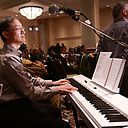
While sitting at the piano with these kinds of thoughts in mind one day, this song began to emerge. It sought to express a confidence in God, albeit a confidence expressed in brokenness rather than in triumph; yet a confidence determinedly holding on to the promises of God - not least the ultimate promise that, one day, God will make all things new.
The second, third and fourth verses were written first, and came together relatively straightforwardly - though with lots of tinkering on the way. The first verse was the struggle, and the writing of it encapsulated the move I had to make from seeing it as ‘my song’, coming out of my particular experience, to one that, hopefully, can be sung by others within their own contexts of brokenness - past, present or future.
John 11:35, the shortest verse in the Bible, it the theme running through this song. I expanded on this verse referring to the death of Lazarus, to cite other examples when Jesus wept, drawing from other gospels as well - the birth of Jesus (Luke 2), Jesus weeping for Jerusalem (Luke 13:34-35) and the death of Jesus (Matt. 27:50, Mark 15:39), and Psalm 30:5 as well. The style of the music is related to plainsong/chant, of course with some modern twists!